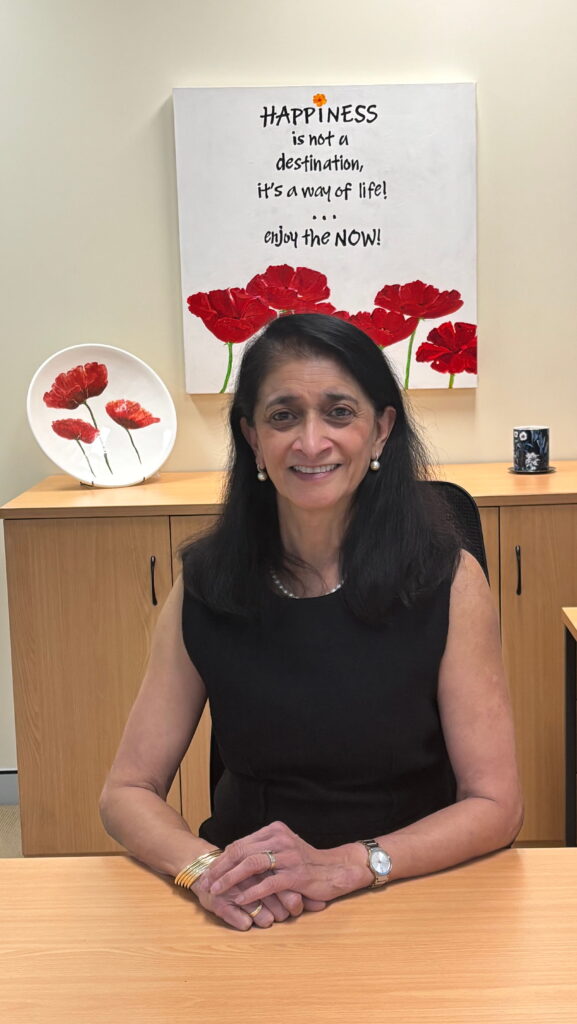
Meet Dr Nirmala Daya: Menopause Doctor Sydney
Dr Nirmala Daya is a Specialist General Practitioner, AHPRA-registered since 1991, and the founder of North Shore Women’s Health (NSWH), a Sydney practice dedicated entirely to women’s breast and gynaecological health, including menopause management. Alongside general practice, she works as a surgical assistant, primarily at Sydney Adventist Hospital, as well as providing ongoing support to women during cancer treatment, with a particular focus on breast cancer patients.
About Dr Daya
In plain terms: Dr Daya is a GP in Sydney’s Upper North Shore who built a practice around a single idea, that women’s breast, gynaecological and hormonal health deserve dedicated time and attention rather than a slot in a general clinic. NSWH has been operating on that basis since 2008.
Dr Daya holds a Bachelor of Medicine / Bachelor of Surgery from Natal University, South Africa (1983), and an AMC Certificate from the Australian Medical Council (1991), the year she took up general registration in Australia. She holds current, unconditional registration with AHPRA in two categories: general registration and Specialist registration in General Practice, the register’s marker of a fellowship-level GP, not simply “any registered doctor.” She completed an internship at Hornsby Hospital before entering general practice on Sydney’s North Shore, where she has now practised for more than 30 years. Over that time she has also worked closely as a surgical assistant to a range of specialists, including urogynaecologists, breast surgeons, plastic and reconstructive surgeons, and obstetricians and gynaecologists, work that has shaped how she manages gynaecological conditions, incontinence and prolapse in her own consultations.
She is a Founding Provider of Menopause Resource Hub. You can find her directory listing here: North Shore Women’s Health, Pymble.
Why this work
Dr Daya has spent her career in a corner of medicine she says was, for a long time, treated as an afterthought.
“It was a very quiet and little known space for several reasons. We were taught very little about menopause during our medical training. In medicine, we are taught mainly about disease and illness, not much about variations in physiology. Menopause, being a natural physiological change that every woman will go through, irrespective of their symptoms or long-term effects, was brushed aside or downplayed, and assumed it’s a variation of a normal range of symptoms.”
She also points to a specific setback in the field: the period, in the early 2000s, when early research wrongly linked menopausal hormone therapy (MHT) to increased risks of heart disease and cancer.
“Many of us were prescribing MHT before MHT was wrongly claimed to increase risks for heart disease and cancer. Hence, many women ceased their treatments and others were too scared to seek treatment. I do feel some of these concerns are still present. Sadly, many of those women have not had the long term benefits of MHT.”
Her own path into the field grew out of a long-standing interest in obstetrics and gynaecology, and years spent working as both a GP and a surgical assistant alongside O&G specialists.
“I have always had an interest in obstetrics and gynaecology having spent extra time training in that field. I work as both a GP and surgical assistant. Over the years I have worked very closely with several O&G specialists who encouraged me to set up a women’s health practice focusing on gynaecological matters and menopause, including supporting women with breast cancer through the difficult perimenopause and post menopausal time.”
What’s changed in how women arrive at their first appointment
After more than 30 years in practice, Dr Daya has a clear read on why most women come to see her.
“Many women make appointments because their symptoms have been dismissed, downplayed, poorly explained and/or poorly managed. Yes, they may have come in anxious because of lack of understanding of what they are going through, or having been previously dismissed.”
Beyond menopause: breast and gynaecological health
Menopause management sits inside a wider practice. NSWH’s services span gynaecological examinations and pap smears, breast examinations and breast cancer support, management of conditions including PCOS, endometriosis and fibroids, contraception (including insertion and removal of implanon, Mirena and non-hormonal IUDs), pre-pregnancy and infertility management, incontinence and prolapse management, and minor surgical procedures. No referrals are required.
“I have been fortunate to have set up and manage NSWH for many years now, which focuses on many gynaecological and breast issues. Over the years, I have had many of my patients go through the change of life and share their symptoms as well as the impact on their emotional, physical and social well being. Another important factor is the impact on libido and intimacy and the resulting effect on their relationship. I have gained so much more insight about menopause directly from my patients rather than from text books and talks.”
What Dr Daya wants women to understand about menopause
Asked about the misconception that has proven hardest to shift, Dr Daya returns to how variable the experience is from woman to woman.
“Menopause is a woman’s journey in life, which every woman goes through. It’s not a disease or illness that requires to be medically treated. We may have medical knowledge but not necessarily the understanding or experience. No female experiences the same menopause symptoms, which can vary in duration and intensity, which adds to the difficulty in diagnosing and appropriately managing their symptoms.”
“You’re too young for menopause”: a second opinion matters
One scenario Dr Daya sees often enough to have a firm view on: women told by another doctor that they’re too young to be menopausal.
“I would certainly encourage her to seek a 2nd opinion or an opinion from someone focused on menopause. Early menopause does draw in a small proportion of women, and they would certainly benefit discussing not only their symptoms, but also the long term consequences of early menopause eg bone health, heart health and cognitive well being. It’s certainly not stress causing menopause as much as the menopausal symptoms having an impact on the patient’s emotional wellbeing.”
She’s right that it isn’t rare. Australian Government figures put premature ovarian insufficiency, menopause before age 40, at around 1% of women, and spontaneous early menopause, before age 45, at around 5%, with the combined figure higher again once surgical and cancer-related menopause are included.
On joining Menopause Resource Hub
Dr Daya’s reason for joining the Hub as a Founding Provider was straightforward: a central, credible place for women to find the right kind of care.
“The appeal was being part of a central resource body that has brought together different practitioners with the primary focus being menopause, and to help patients easily find the appropriate care.”
Her advice
Asked for the one thing she’d want every woman to take from her years in this field, Dr Daya keeps it simple.
“Her quality of life, both physical and emotional, as a woman, wife, partner, mother, daughter, aunt, is what matters most, and she can have MHT for her symptoms.”
On what a woman should expect walking into her first appointment: “That she will be given time, attention and a thorough medical assessment for her menopausal concerns and her ongoing care.”
Working with Dr Nirmala Daya
Clinic: North Shore Women’s Health, Suite 6, Level 1, 55 Grandview Street, Pymble NSW 2073
Focus: Menopause management, breast and gynaecological health, contraception, incontinence and prolapse, pre-pregnancy and infertility care
Format: In-person consultations, no referral required, private billing
Phone: (02) 9144 4577
Connect: nswh.com.au
View Dr Daya’s full listing on the Hub: North Shore Women’s Health, Pymble, Sydney.
Frequently asked questions
Can a GP prescribe menopausal hormone therapy (MHT)?
Yes. GPs, particularly those with a dedicated women’s health focus, are able to prescribe and manage MHT, and are often the first and ongoing point of contact for menopause care in Australia.
What does “Specialist General Practitioner” mean?
It’s a distinct AHPRA registration category, held alongside general registration, that recognises a GP practising at fellowship level, not a claim to be a gynaecologist or other medical specialist. Dr Daya’s practice, North Shore Women’s Health, focuses specifically on breast and gynaecological health, including menopause. She works closely with specialists (gynaecologists, breast surgeons, oncologists) as a surgical assistant and through the SAN Integrated Cancer Care Centre, and refers on for surgical or specialist-level care where it’s needed.
Where is Dr Daya based?
North Shore Women’s Health is located in Pymble, on Sydney’s Upper North Shore. Consultations are in-person, by appointment.
I’ve been told I’m too young for menopause. What should I do?
Seek a second opinion, ideally from a GP or specialist with a genuine menopause focus. Early menopause (before 45) and premature ovarian insufficiency (before 40) affect a meaningful minority of women and carry long-term implications for bone, heart and cognitive health that are worth discussing directly.
Who is Dr Daya’s care best suited to?
Women seeking a GP with deep, long-standing experience in menopause, breast and gynaecological health, particularly those who feel their symptoms have previously been dismissed or poorly explained, and women navigating perimenopause or menopause alongside a breast cancer diagnosis or treatment.
Why this matters
Founding Providers are the practitioners who chose to back the Menopause Resource Hub before it was easy to do so. Their willingness to be visible, named and reviewable is part of what makes the directory worth trusting. Dr Daya is one of them, and more than 30 years spent building a practice around women’s breast, gynaecological and menopausal health reflects exactly the kind of grounded, experienced care the Hub was built to make easier to find.
Provider Spotlight is an editorial series featuring practitioners listed on the Menopause Resource Hub. Listings and Spotlights are not clinical endorsements. Always discuss your care with your treating practitioners.

Author: Sharryn Ludlow
Sharryn Ludlow is an Australian founder and strategy-and-operations practitioner. She is the founder of Menopause Resource Hub (AU), a curated directory helping women find menopause-informed support. Sharryn has worked across travel operations, group logistics, and project support for over 20 years, and is known for a direct, grounded style that cuts through noise and focuses on what works.