What women are telling us about menopause in Australia, 2026
The conversation about menopause in Australia is louder this week than it has been in months. I watched it unfold in my own feed, and joined in myself. A senior executive in the travel industry posted on LinkedIn about the cost of her hormone replacement therapy. Seventy dollars a month. Then, a comment later, a $140 shock on a different script. In the replies, senior, professionally networked women were openly admitting they had no idea what was actually listed on the PBS in 2026, what wasn’t, or why two women on what sounded like the same medication might be paying wildly different amounts.
That conversation isn’t unusual. It is the conversation. Every week, women across Australia are having some version of it. In workplaces. In Facebook groups. At school gates. With friends. About cost. About what doctors will and won’t prescribe. About symptoms nobody warned them about. About whether menopause is meant to feel this hard.
I started building Menopause Resource Hub because the conversation about menopause in Australia is everywhere, and the response from the system is nowhere near where it needs to be. Here’s what I’m hearing.

Four patterns from the conversations this month
Cost confusion is now systemic
Some women pay $25 a month for body-identical hormone therapy through the PBS. Others pay $70, $140, or more for what sounds like a similar prescription. Senior, informed, professionally networked women are publicly admitting they have no idea what is listed and what isn’t. Their GPs aren’t reliably telling them. Even the women trying to help each other in online communities are getting the prices wrong.
Part of the confusion is real and structural, not just a communication gap. Not every hormone therapy product is PBS-listed, newer formulations in particular often aren’t, and Australia’s ongoing HRT patch shortage has pushed some women onto substitute products that fall outside the PBS altogether. Two women on what looks like the same treatment can genuinely be on different, differently priced products without anyone explaining why.
Care is being refused without basis
This week alone, a woman was denied hormone therapy because of a routine cervical procedure two years ago, despite clear results since. Other women are being refused testosterone despite Australian guidelines now supporting its use for low libido specifically, one of the few areas where the evidence is clear. Some are having treatment stopped against their will after they finally felt well. There is no obvious appeal route. Most women don’t know they can ask for a second opinion, or where to find one.
The information vacuum is being filled by peers, not professionals
On a single Facebook thread of one hundred-plus comments, women are giving each other medical guidance because qualified guidance is too hard to find. The groups have moderators doing real work to correct the worst of it, but no volunteer can be across every comment. Peer support, however well-intentioned, is not the same as personalised clinical care. This is how women are making decisions about their bodies in 2026.
The emotional toll is severe and openly named
“Living in survival mode.” “Does it ever get better?” One woman this week asked, publicly, whether menopause was meant to be the end of women’s useful lives. These are not outlier voices. They are the volume of the room.
Why menopause in Australia needs this directory
Australia’s primary care model places enormous weight on the GP. They are the gatekeeper, the prescriber, the referrer, the default source of trust. For perimenopause and menopause, many GPs are not yet equipped to carry that weight. Not because they don’t want to. Because training in this area is still catching up to demand, and ten-minute consultations cannot do what is actually needed.
The result is the conversation you’ve just read.
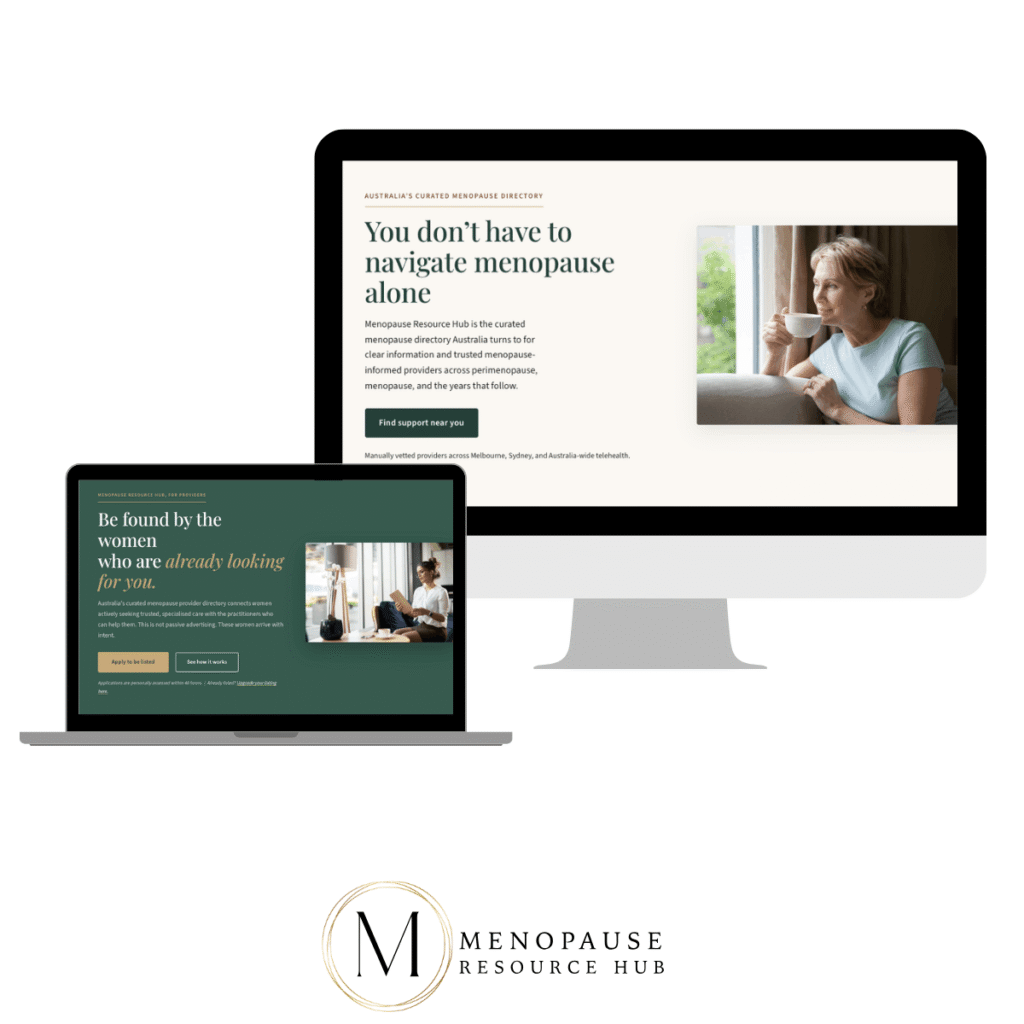
Curating a directory of practitioners who are trained, who are current, and who refer well is the most direct response we can make. Every practitioner on Menopause Resource Hub is vetted before listing: naturopaths, pelvic health physios, counsellors, nutritionists, integrative doctors, menopause-trained GPs. Together they form something that doesn’t otherwise exist in any single place in Australia. A referral network designed around the woman, not the system.
What we’re building
More than 160 vetted practitioners are now listed across Melbourne, Sydney and Brisbane, drawn from over 325 applications reviewed. Roughly half don’t make it through vetting. That bar matters more to us than the size of the list.
A free Appointment Ready workshop is open for women, designed to help them walk into their first menopause appointment prepared. Symptoms documented. Questions written. A clearer sense of what they need.
In build now: a practitioner-matching tool that routes women into the directory based on their primary concerns. Better-fit referrals, with the matching work done before the call is made.
If you’re reading this
If you are a woman trying to navigate this, visit the Hub. Take the workshop. You shouldn’t have to do this alone, or from Facebook at 1am.
If you are a practitioner with the training and the care, get in touch. The vetting process is rigorous. The mission is bigger than any single listing.
If you work in policy, workplace wellbeing, media, or any space where women’s health intersects with the work you do, the conversations above should disturb you. They disturb me. They are the reason I am spending every spare hour on this.
Menopause in Australia in 2026 should not be defined by a hundred-comment Facebook thread at 1am. It can be defined by something better. We are building that.
Sharryn Ludlow
Find support near you
Browse menopause-informed GPs, specialists, allied health and telehealth providers, vetted for relevance across Melbourne, Sydney, Brisbane and beyond, in our national directory. Or start with the free Appointment Ready workshop.

Author: Sharryn Ludlow
Sharryn Ludlow is an Australian founder and strategy-and-operations practitioner. She is the founder of Menopause Resource Hub (AU), a curated directory helping women find menopause-informed support. Sharryn has worked across travel operations, group logistics, and project support for over 20 years, and is known for a direct, grounded style that cuts through noise and focuses on what works.